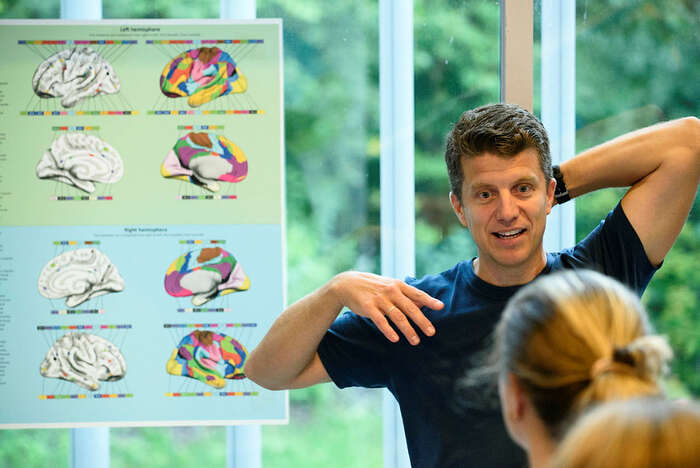
LCBC has traditionally participated every year at the Science Expo at the Teknisk Museum, which is organized by the Faculty of Medicine at the University of Oslo. This year, like last year, LCBC will have a stand, where children, adolescents and adults can learn more about the brain! Both young and old get a sneak peek into the world of research in a fun and educational way.
News
The Centre for Lifespan Changes in Brain and Cognition (LCBC) has been awarded 1.28 million euro by the EU to coordinate a major European research project that will investigate the relationship between pollution, brain health and brain disorders.
A new study shows that Alzheimer's disease can be detected via imaging more than seven years earlier than previously thought. Researchers from the Department of Psychology at the University of Oslo have led the study, which is published in the journal Nature Neuroscience.
The Faculty Board of Social Sciences at University of Gothenburg has appointed the honorary doctors for 2026. Two professors of psychology have been awarded the distinction: Moin Syed of the University of Minnesota and Kristine Beate Walhovd of the University of Oslo.
The Fridtjof Nansen Prize for outstanding research in the humanities and social sciences is awarded to Kristine Beate Walhovd and Anders Martin Fjell.
Babies cannot do much when they are born, but they acquire complex physical skills very quickly, from reaching and grasping to sitting, crawling, and walking. They also sleep a lot, often more than half the day. How do babies move from almost no motor control to advanced movements during a period when they spend so much time asleep? Liisa Raud, a researcher at LCBC, has just been awarded a NOK 2 million project grant from the Research Council of Norway’s Radical Research Ideas programme.
The Centre for Lifespan Changes in Brain and Cognition (LCBC) at the Department of Psychology has received NOK 2 million from the Research Council of Norway to build a Nordic research network that will digitalise historical health registries and population data.
Women’s brains age more slowly, but that doesn’t seem to protect them from a common form of dementia. Nearly twice as many women are diagnosed with Alzheimer’s disease as men, and ageing is the biggest risk factor for the disease. This has prompted research into age-related sex differences in the brain. “If women’s brains declined more, that could have helped explain their higher Alzheimer’s prevalence,” says co-author Anne Ravndal, a PhD student at the University of Oslo.
Our hectic modern lives can often leave us feeling sleep-deprived, but what if much of a good night's sleep was down to our state of mind? LCBC and Anders Fjell has been included in a BBC article.
Anders Fjell, leder av LCBC ble intervjuet av forskning.no om en ny studie publisert i PNAS. Studien sier at å bli foreldre ser ut til å beskytte hjernen mot aldring – hos både menn og kvinner. Effekten kommer av livsstilsendringer når man blir foreldre, tror forskerne. Anders Fjell er skeptisk til studien.
Spending more time at school could keep you sharp into old age, but there are other factors that might explain the effect. A current LCBC study found that while education correlated with better memory and a larger brain volume, which supports cognitive resilience, it didn’t ward off age-related decline. Anders Fjell, leader of LCBC got interviewed by New Scientist on education.
LCBC has traditionally participated each year at the Science Expo of the Medical Faculty of the University of Oslo, at the Technical Museum with exciting activities. The public had the opportunity to meet brain researchers and learn about heart research, nutrition, prosthesis production, and how sustainability and health are interconnected. Both adults and children got a sneak peek into the world of research in a fun and educational way. We are very proud that LCBC won the Best Booth Award at the Science Expo. See you in 2025!
"Norway has high-quality brain research data that we in the USA can only dream of," says Anders Martin Dale. He visited Norway in September in connection with being awarded an honorary doctorate for his groundbreaking brain research. Read the article here (in Norwegian) about his public lecture and seminar at the Department of Psychology, held 4th September 2024.
The usual advice is that we need to get eight hours of sleep every night for the sake of our health. But now, research suggests the impact of getting less sleep than that has been exaggerated. In fact, getting as little as six hours of sleep a night is probably fine for physical and mental health. Clare Wilson in i News recently published an article on the main outcomes of a sleep study at the Vanderbilt University, US. Anders Fjell has commented on the results.
The largest analysis of brain scanning data yet casts doubt on the idea that shorter sleep duration is linked to shrinkage of the brain. Below we summarise the interview Claire Wilson medical reporter at the New Scientist conducted with Anders Fjell in October 2023.
Kristine Walhovd commented on recently published Spanish and American studies regarding the so-called "super-agers". There is strong evidence that those who function well in older age have also functioned well in younger years. The differences observed initially do not disappear. The Norwegian study on super-agers finds that the characteristics related to good memory in older age are the same as when you are young.
Given that sleep deprivation studies consistently show that short sleep causes neurocognitive deficits, the effects of insufficient sleep on brain health and cognition are of great interest and concern. Here we argue that experimentally restricted sleep is not a good model for understanding the normal functions of sleep in naturalistic settings.
Overweight increases the risk of dementia, as shown by numerous studies. However, some researchers question whether that is the case. Svenska Dagbladet has interviewed Kristine Walhovd among other researchers on the risk factors of dementia. Below you find a summary of the interview conducted by Maria Jelmini published 3rd June 2024.
Did you know that a Norwegian has developed the world's most widely used tool for studying the brain? Anders Martin Dale grew up 50 meters from the physics building at UiO and is now being honored as an honorary doctorate at the Faculty of Social Sciences. Dale has spent his research career in the USA, at Harvard and the University of San Diego, but has had a tremendous impact on Norwegian brain research. At UiO, Dale has been a strong collaborator for LCBC and numerous researchers at the Department of Psychology and the Faculty of Social Sciences.
The Department of Psychology has established a new core facility, CAPRO (Capture and Processing of Life Science Big Data for the Social Sciences and Humanities). The core facility is a service platform for researchers in human quantitative life sciences and social sciences, offering expertise in the acquisition and processing of large/complex datasets containing sensitive personal information.
Project leaders are Professor Kristine B. Walhovd and Professor Espen Røysamb. Operative director is researcher/software engineer Athanasia Monika Mowinckel.
They research on how our brain changes from birth to death. They aim at finding answers to why we develop so differently and understanding the factors explaining these variations. For instance, why do some people develop Alzheimer's disease while others remain unaffected? What can we do to prevent unfavorable brain developments and live the best possible life?
The "Promoting Functional Brain Maintenance – Insights from Successful Agers" project led by Harvard College got funded by 500 000 USD by the Simons Foundation in the US and will start 1 January 2024. LCBC is a collaboration partner in the project along with Umeå University and University of Chicago.
We congratulate Yunpeng Wang and Øystein Sørensen for their professorships. They have joined LCBC in a tenure track position in 2018 and got their professorship from 1 January 2024.