
Difference discovered in twins
Brain researcher makes striking discovery after studying twins.
We are frequently reminded that exercise and moderation are important for keeping the brain in good shape.
However, it is not only the things we do as adults that are significant factors in the risk of developing dementia, says Kristine Walhovd.

The answer came as a surprise
For nearly three decades, the professor of neuropsychology at the University of Oslo has studied how the brain develops.
Research shows that the brain is less malleable in adulthood than is commonly perceived.
“Although we can continue to learn throughout our lives, our capacity to structurally alter our brains as adults is limited,” the neuroscientist explains.
“Differences in cognitive ability among primary school pupils will still be evident when they meet again at the age of 70.”
Her research has been published in a number of medical journals and platforms, including National Library of Medicine, MedRxiv, og Communcations biology.
Paradox
"To me, it is somewhat paradoxical that we invest a great deal of resources in preventing disease in old age—conditions that I believe might be better prevented at an early stag."
For the central nervous system begins to form very early in pregnancy.
"Several processes involved in the development of the central nervous system take place exclusively during fetal life," she says.
Weight is a factor
When children have different birth weights, this can partly be due to conditions during fetal life.
The researchers found that variations in birth weight are linked to characteristics of the brain throughout life.

Walhovd recruited twins from the national twin registry. Even identical twins usually have slightly different weights at birth.
Twins provided answers
She studied 210 twins, aged 16–78.
In genetically identical twins, the link between birth weight and differences in the cerebral cortex remained evident much later in life—regardless of whether they were 20 or 70 years old.
“The twins might have consumed different amounts of alcohol, had different blood pressure levels, engaged in varying degrees of physical activity, or had different body weights as adults—yet none of these factors had a significant impact on the differences in their brains.”
“What did matter was the difference in birth weight.”
Consequently, differences in the brain cannot simply be attributed to lifestyle, she explains.
Extensive studies
Research, including from Harvard, shows that the relative prevalence of dementia in the West is falling, while obesity—and to some extent physical inactivity—among the elderly is on the rise.
Consequently, researchers in Oslo are looking for explanations other than lifestyle.

Today’s older adults—those born after the war—have benefited from a better starting point than previous generations, likely from the very beginning.
Generational Advantage
“Brain development during the early stages of life has a profound impact on health and disease throughout one’s entire lifespan,” says Walhovd.
At the Congress on Children and Youth in Bergen, researchers and professionals emphasized the importance of a child’s first years of life.
“The first 1,000 days shape both mental and physical health,” stated researcher Kari Slinning from RBUP East and South.
Risk multiplied
“Environmental factors that can affect the brain—such as alcohol or drugs—can be associated with a sevenfold difference in impact if the exposure occurs during fetal development rather than in adulthood,” says Walhovd.
Thus, the beginning of life is of great significance.
“Factors early in life are linked to the risk of dementia. How well we function as children—our cognitive function—can account for a portion of the risk of dementia,” Walhovd explained to an attentive audience.
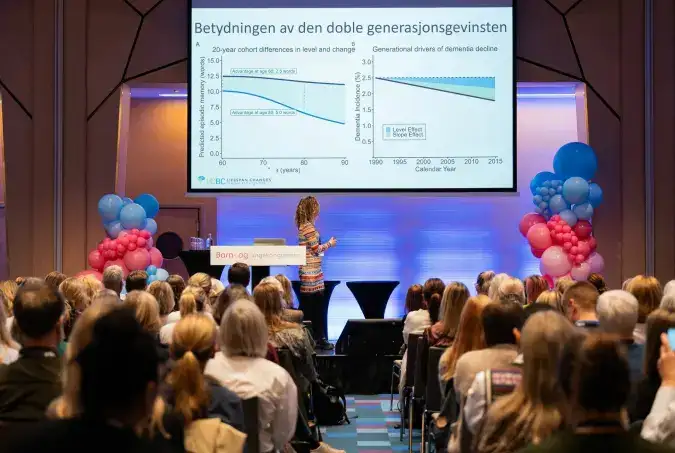
The speakers’ clear message is that early intervention during pregnancy and the toddler years pays dividends for the rest of one’s life.
“I would place a great deal of emphasis on ensuring good conditions for children and families. There are so many years during which we can reap those benefits—provided we get things right from the very start.”
The start is what matters most
“Factors such as birth weight have a lifelong impact on the brain,” says Walhovd.
It is far from just our actions as adults that carry significance.
“The cognitive abilities of an 11-year-old are, to some extent, predictive of dementia in later life.”
After the presentation, one of the audience members, Bjørn Brunborg, spontaneously exclaimed:
“I have to call my mom and ask what my birth weight was!”
Link to article: Tvillinger ga hjerneforskere svar